

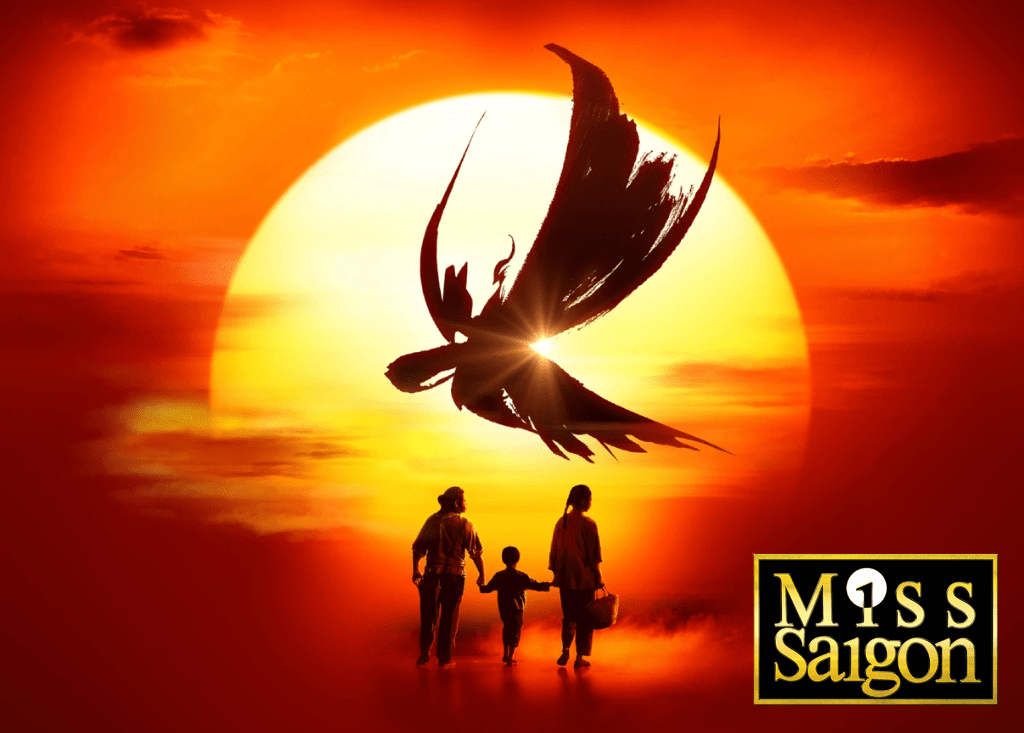
For many years I have shown little to no interest in watching Miss Saigon. A musical that’s been around since 1989 but has been constantly dogged by controversy regarding the storyline, characterisation and lyrics. These problems, which can be read about here rather than me repeat them, have deterred me from watching something that I felt I was unlikely to enjoy and have a differing opinion on.
However, when it once again rolled around on its current UK tour to Manchester’s Palace Theatre, I decided that perhaps I should watch it once to make my own mind up – and when the tickets were only £20 each (albeit for poor seats), it wasn’t too much to pay. Of course, even when doing so it is impossible to not already be influenced by what you know, but I did my best to go in with an open mind. So what did I think?

Below are my thoughts on the show and in some cases, this current production:
Chris and Kim’s romance
Miss Saigon is described by many as a tragic love story due to Kim’s undying love for Chris until the very end. However, it’s difficult to determine Chris’ feelings towards her. Early in the show he clearly has feelings for her but he is baffled by the seriousness of the so-called wedding before being distraught at having to abandon her. He later still has dreams and nightmares of his time in Vietnam and of Kim but ultimately recovers and marries Ellen. When he hears news of her it is obvious he has still been thinking of her, though this is not necessarily in a romantic sense but out of concern of whether she has survived.
Upon Kim meeting Ellen, Kim declares she still loves him but Chris is hesitant to admit that their marriage is real and ultimately chooses Ellen, only thinking of Kim and their son in a “I’m the father so must help” kind of way. When Kim shoots herself Chris is distraught, but that does not mean he still loves her. Miss Saigon is overall, a one-sided romance, where Chris’ “White Saviour” trope that is depicted at the beginning of the story is pushed aside by Kim’s naivety and almost immature view of marriage and love that is portrayed.
Miss Saigon vs. Mr Engineer
Although recent productions since the 90s have finally moved away from hiring actors with no ESEA heritage to play Mr Engineer, the Eurasian hustler, it has still not moved away from ensuring he is a more principle character than anyone else. I was unfortunately not impressed by Seann Miley Moore’s over-the-top portrayal. The Engineer’s character has always been known to be overindulgent, self-obsessed, and shows little regard for the feelings of others unless it impacts his own gain, but was amplified by Moore pulling focus from others when on stage, speaking and singing like a character from a Cartoon Network show, and behaving like the ringmaster of a circus show where only he matters and his performers are secondary. I am rather intrigued though to see how the alternate Engineer actor Aaron Teoh portrays the same character…
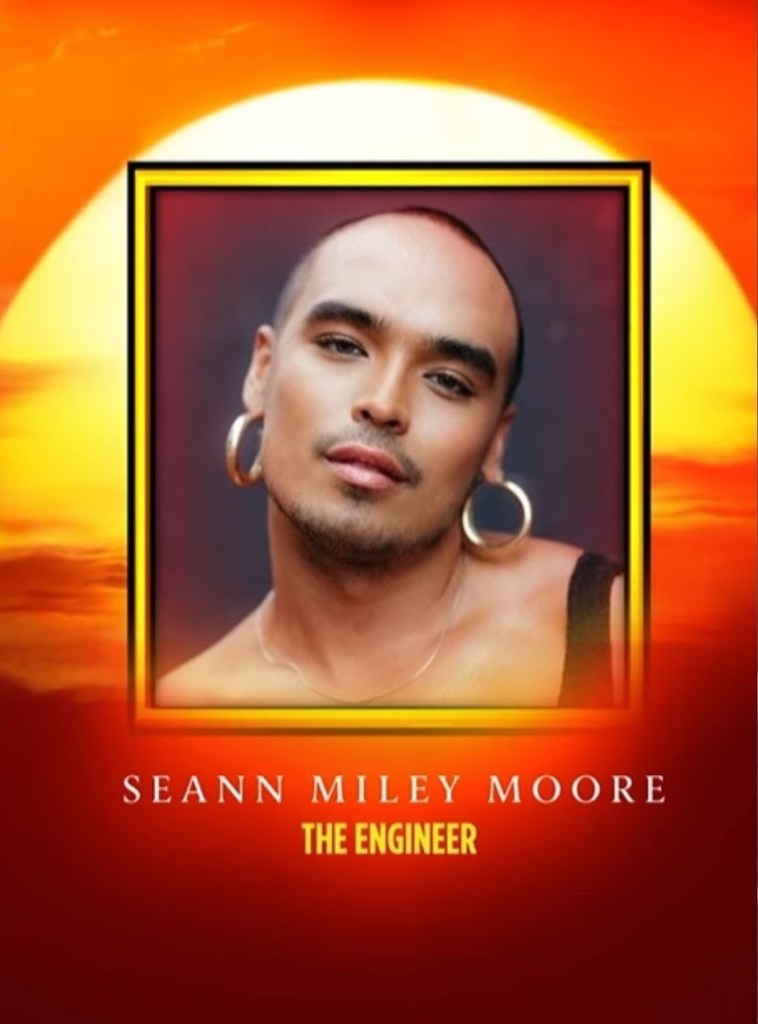
As perhaps the only actor in the company who has garnered fame beyond musical theatre (if you can call being a finalist on The X Factor in 2015 when the show was dying out and he was nowhere near the quarterfinals let alone the winner, fame), Seann certainly did receive a great deal of audience applause. But I feel it was misplaced. Half the time he was difficult to understand, looked like he is someone who revels too much in attention beyond the character and off stage, and should definitely not have been the last cast member to come out at the end and take the final bow. Isn’t this show meant to be called Miss Saigon, not Mr Engineer?
Orientalism, racism, and misogyny
No matter how you might try and rework Miss Saigon and try to retain much of the original, without making major changes to almost everything, some of the underlying issues will always continue to remain. Kim is still portrayed as naive, virginal, submissive, and longing for her White Saviour, while the other girls under The Engineer are there only for the White male gaze, are seen as promiscuous, and fulfil the “Dragon Lady” stereotype due to being hardened and confident in comparison to Kim. Meanwhile, Vietnam and Thailand are still described negatively by nearly all characters, including those who live there – as dirty, backwards places filled with brothels, that are ravaged by war, taken over by Communists, and the people are poor, desperate to get away and be rescued.
These ideals are still present in the current production. If anything, there is the extra trope that has been added as Seann Miley Moore’s turn as The Engineer, who has never been quite as flamboyant or overtly queer in older productions. Moore’s interpretation enforces the stereotype of Asian men being effeminate and still submissive to White males as he shamelessly flirts with clients who are not interested in him and his desperation for a visa to leave and live in America verges on annoying and cringe.
Casting and representation
For many who take on the Asian roles in Miss Saigon, I can imagine it is a dream job. With so few main and supporting characters in most musicals being ESEA, it is difficult to get roles that are not non-descript ensemble and swing. The only other option except Miss Saigon where your chances are high lie with The King and I, or even to some extent, Aladdin. While of course it’s a boost for ESEA representation on stage, this is still far and few between when these shows only tour sporadically. And when a show like Miss Saigon carries so much controversy historically, is it something actors can carry morally? Is that true representation and diversity or just a way to tick boxes without change?

That rhetorical question is not for me to judge but I can understand the predicament some may find themselves in – it’s a big role in a famous show and a potential foot in the door to bigger and better roles. But at the same time, that is never a guarantee. Looking at the two actresses sharing the role of Kim – Julianne Pundan and Bea Ward – this is their first lead role in a major production and it will be interesting to see where their careers take them in the future. For out of all the actresses who have played Kim, for example, how many have gone on to have numerous lead roles in other shows? Lea Salonga, the first actress who did, is still the only one who has found global fame, yet this is more thanks to her screen credits rather than the roles she has taken on stage. That is more down to the lack of representation off-screen advocating for ESEA talent, systemic racism and minority wars (see how many Black actors instead have taken on roles traditionally played by White actors), not because they are not as good.
So how was Miss Saigon?
As far as musicals go, I found Miss Saigon to overall, be very middle-of-the-road. Although most of the music and songs are beautiful (particularly those sung by Kim), many were also largely forgettable. As a story, it was rife with aforementioned problems, however covert they may have been to the majority of people watching, and while certainly full of emotions, it’s a musical that would rank at least on the lower half of a list of all that I’ve seen. This is even without taking into consideration the controversy. Miss Saigon was by no means terrible but it was decidedly average at best and unfortunately a majority decent company and a few choice songs can’t save it from drowning in a sea of far more interesting musicals – both old and new – more than anyone could have saved poor Kim.

 Tan's Topics
Leave a comment