

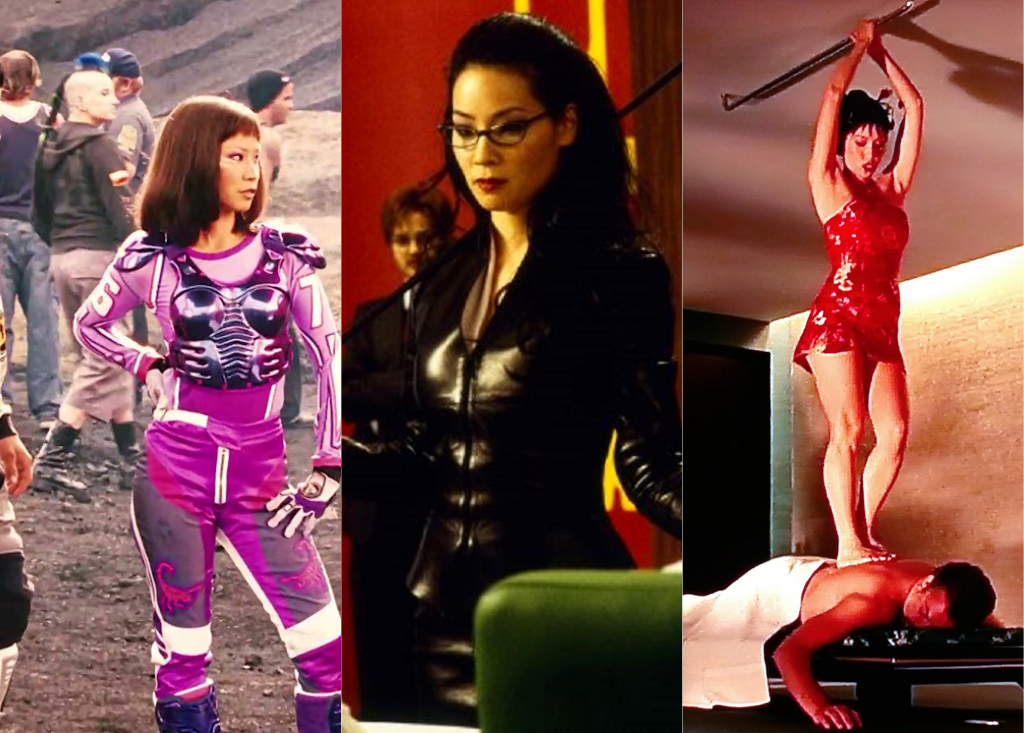
Posted on 27th June 2025 to mark the 22nd anniversary of Charlie’s Angels: Full Throttle.
Before Lucy Liu co-starred as Alex Munday in Charlie’s Angels in 2000 and its sequel Full Throttle in 2003, she had already been in more than a dozen films. These include her big-screen debut with a small supporting role in Rhythm of Destiny in 1992, as a former girlfriend of Jerry Maguire’s in the 1996 hit, and as fan favourite Princess Pei Pei in Shanghai Noon. She was, however, perhaps best known for her TV role as Ling Woo in Ally McBeal.
Yet arguably, she wasn’t globally known as a big star until Charlie’s Angels and her success and stardom still paled in comparison to her co-stars Cameron Diaz and Drew Barrymore. The former had debuted in the blockbuster The Mask in 1994 and the latter had started out as a child actress in 1980, two decades before. So it’s understandable that Liu had some catching up to do. Even when she got the role of Alex she was the last of the main cast to be hired (she reportedly replaced Thandiwe Newton) and her two new co-leads were already firm friends from long before.
But it was seen as a positive step in Hollywood. One of – in fact, perhaps the only – major Asian female actress of the era since the likes of Anna May Wong and the women who starred in The Joy Luck Club to land such a coveted role in a surefire smash. She undoubtedly paved the way for the countless Asian American actresses who have found success since then, from Awkwafina and Constance Wu to Kelly Marie Tran and Lana Condor. But her character was tainted with possessing or living up to Asian stereotypes and traits from the beginning.
Here are some:
1) The intros showed her to be sensible and a high achiever compared to the other two
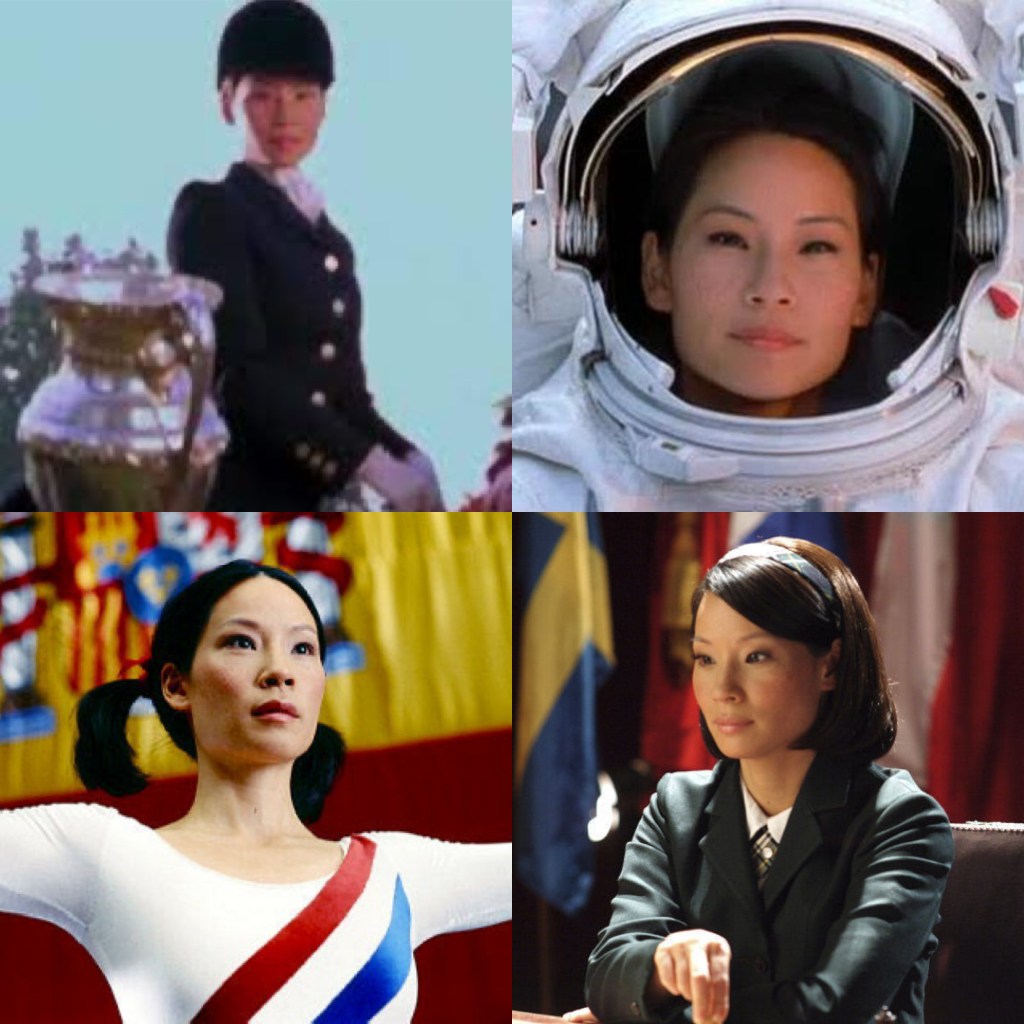
In the iconic “once upon a time there were three very different girls… who all grew up to be three very different women” opening, Alex is depicted as a decorated horse rider and an astronaut in the first film. In its sequel she was a champion gymnast and then a champion chess player. Meanwhile, in both films, the other two are shown to be a goofy teenager turned pretty TV show contestant and then a vet (Natalie) and a punk rocker turned even punkier rocker in the form of a police cadet, lucha libre wrestler and monster truck rally driver (Dylan). Although all three certainly reflect their personalities, it’s telling that Alex is shown to be an overachiever and the least exciting and dynamic of them all.
2) She seemed the least fun and laughed the least
Natalie and Dylan were goofy and gigglers, and though Alex laughed along with them sometimes, she definitely didn’t all the time. One example is when the other two are throwing her “Chinese fighting muffins” at each other, while she is being grumpy. Another shows her as the more mature and insightful one when she points out to Dylan that one day the three of them won’t be together.

She was also dismissive – even rude – to two guys who tried chatting her up in both films, and often kept Jason at arm’s length. Compare that attitude to Natalie who is instantly attracted to Pete and constantly gushes over him and Dylan who is happy to flirt with a number of men, and Liu once again fulfils the “Dragon Lady” stereotype. Oh, and let’s not forget the role she played as the hypersexualised, unsmiling, no-nonsense, whip-cracking “efficiency expert” in the first film and in the sequel’s Treasure Chest dance sequence she was also the stony-faced whip-cracking one.
3) She was considered the most skilled fighter
Of course her character had to be a martial arts master so to say she “knew kung fu” is a bit of a sweeping, unfair statement (though still a stereotype). But Lucy still came across as the best and most realistic fighter of the three. And she’d already done some martial arts acting before (her one scene in Shanghai Noon is rather cool) and studied it when she was younger. But in a BTS special of the film it’s clear Alex was meant to be more versatile, as described by one of the stunt coordinators as a good mix of both Natalie and Dylan’s fighting styles (skip to 3:08 in the video below).
4) She wore chopsticks in her hair once
And as a masseuse, of all things, while the other two did not give the massage… It was a cute look but need I say more?

However, these four points aside, Alex Munday’s character is given way less thought to in the stories than her friends. In the first film, Natalie is shown having fun with Pete and overall is clearly (without the laborious task of counting minutes) given more screen time, while Dylan’s fling with bad guy Knox is also a central part of the plot. Alex on the other hand, is only briefly shown preparing a meal before her and Jason’s trailer is attacked.
In Full Throttle, her dad comes in and Jason tries to re-enter her life too, but beyond that and some hilarious double entendres regarding explaining her job, it is once again Natalie and Dylan whose backstories and characters are developed further. Natalie as the unspoken leader (she’s nearly always in the middle of the three in their “ass-kicking poses”) goes toe-to-toe with Madison Lee and her relationship with Pete progresses, while Dylan’s past coming back to haunt her, which takes up and forms much of the film’s plot.
Poor Alex’s naive dad (who of course thought and hoped she was a top doctor, like all good Asian children should be) and oblivious Jason barely get a look-in; they could have easily not been in the film at all, and were only aided by their actors’ famed comedic timing.
And then there’s the glaring issue of salary disparity between Lucy and her co-stars. While it is common in Hollywood for an actor to be paid according to their previous successes and as we established Liu’s resume was nowhere near as impressive as the other two’s, reports say she was paid a measly $1 million for the first film. It is said that Drew took home $9 million (even as a producer) and Cameron $12 million. For Full Throttle, those paycheques were 4, 14 and 20 million dollars, respectively.
In between the two films, they had varying successes after the first one. Cameron starred in multiple hit movies including Shrek, Vanilla Sky, The Sweetest Thing and Gangs of New York. Meanwhile Drew was in Donnie Darko but two other films she starred in both bombed at the box office, and Lucy also had some misses such as Ballistic: Ecks vs. Sever (one of the worst-reviewed films in the history of Rotten Tomatoes) and one hit in Chicago (though in a minor role) before finding success again with Kill Bill Vol. 1 just after Full Throttle’s release. You’d think then that would explain her continued smaller salary in the sequel (Drew was a producer again and her long-standing celebrity status hadn’t suffered, hence the still higher pay), but does it not put into question the lack of equality and equity that still exists in Hollywood? Couple that with Liu’s double minority status, and it further questions the issue of discrimination and representation.
And when such alleged news of salaries is made (or leaked) to the public, if you were the lowest paid but didn’t (or perhaps did) know, how humiliated or angry would you feel, knowing Hollywood’s fickle pay scale or not? In contrast, all six of the main cast of Friends eventually earned the same amount per episode ($1 million), even when individually they had varying amounts of success outside of the show. However, as Lucy says in the above video, she worked hard just to have money, so perhaps those first few paycheques in her career was just “fuck you money”? She went on to apparently earn $5.5 million for Kill Bill and $125,000 per episode of Elementary, which ran for 154 episodes (that’s a whopping $19,250,000 earned throughout).
Charlie’s Angels undoubtedly helped put Lucy Liu on the map and her appearance certainly bolstered the limited array of Asian faces on the big screen. The two films are, admittedly, ones I love to watch, but looking deeper into Alex’s characterisation and Liu’s subsequent career in comparison to her co-stars, one must ask oneself – is all that a product of conscious deliberateness or not?
 Tan's Topics
Leave a comment