


The risk any filmmaker takes when remaking a classic film is that it will not only obviously draw comparisons with the original, but will more often than not – especially when the original was well-received already – be derided as derivative or unnecessary. Ang Lee’s The Wedding Banquet from 1993 holds a 91% rating on Rotten Tomatoes and won accolades at Taiwan’s Golden Horse Awards, GLAAD Media Awards and Berlin International Film Festival, among others, plus made nearly $24 million at the box office on a tiny $1 million budget.
So did The Wedding Banquet need a 21st Century take by director Andrew Ahn (whose two films Spa Night and Fire Island both made it onto my list “30 21st Century Asian American films pushing the envelope on representation”) on the already progressive if rather bizarre premise of the film? Perhaps not considering the success of the original but remarkably, it works, without its changes seeming too forced or unbelievable, and still manages to be just as emotional and dramatic but also funnier.
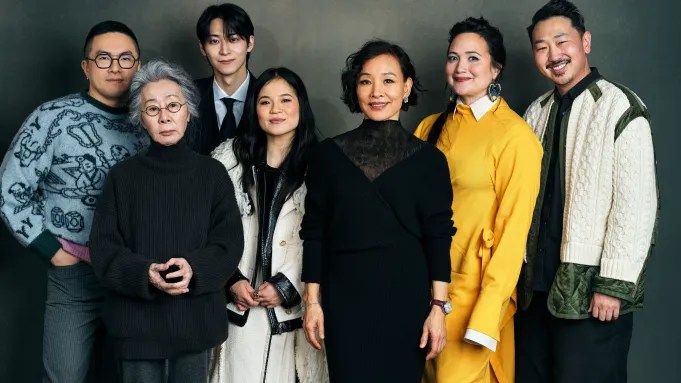
The story follows two queer couples – lesbians Angela (Kelly Marie Tran) and Lee (Lily Gladstone) and gays Chris (Bowen Yang) and Min (Han Gi-chan) – who live together on Lee’s family property in Seattle (the lesbians in the house and the gays in the shed – or “guesthouse” as they call it). Angela and Lee are trying for a baby via IVF, while Chris and Min are in a long-term relationship that doesn’t seem to really be moving forward. But when artist Min’s seemingly overbearing grandmother (Youn Yuh-jung) pressures him into returning to Korea to work for the family business and Lee’s IVF treatment fails, a crazy, tipsy idea comes into their minds… For Min to marry Angela so he can stay in America and avoid doing what he doesn’t want to in exchange for the money for Angela and Lee to retry IVF again. Although in the original, the “sham marriage” was for Wei-Wei to a green card, that reason is questioned as a motive but dismissed, probably because of the stereotype it insinuates.
While of course it would have been a lot easier for either Chris or Min to donate their sperm – if they wished – to Angela and Lee and save them the money, Min is desperate for a reason to not join the family business so he can continue living his own life. But then when his grandmother pays a visit to meet his bride-to-be, she does so amidst chaos. Chris and Min argue because the former refuses to marry his boyfriend of five years and Angela and Lee fall out because Angela dares to suggest they go travelling first instead. Angela also battles her inner turmoil of becoming a mother because of her own’s (Joan Chen) parenting skills, especially when she came out. What more could happen? Well, a lot more drama and shock truths apparently…
Some aspects of the original film are referenced or kept, such as the couple being pushed into hosting a lavish wedding banquet (of course, because that’s the name of the film – but this time it’s a traditional Korean ceremony) and getting officially married with a license at City Hall, and someone falling unexpectedly pregnant… But ultimately, the characters and their individual stories are different and nuanced, making them separate entities to the original film’s.

My only criticism would be that so much more context could be expanded upon and characters and storylines could be explored further, runtime dependent. For example, Chris and his cousin Kendall (Bobo Le) – who is quite a minor supporting character – mention their family and some unmentioned family drama back home in Kansas yet it is never elaborated on; you never hear any mention of or see Lee’s family; and Angela’s strained relationship with her mother May is one of the main interwoven subplots but what happens with May’s fulfilling life as an influential and inspirational PFLAG when things going haywire is left unknown.
Apart from that, The Wedding Banquet is a more than satisfactory remake of the 32-year-old original, which while that still holds value as a cinematic piece ahead of its time, is given a fresh, modern leash of life. With interesting and sometimes unexpected but also welcome changes to both the story and characters so they are not just cut and pasted, this remake is as respectful of as it can be whilst still being funny, wholesome, heartwarming and different enough to stand on its own and enjoyable. And ultimately, especially for LGBTQ, Asian American and ESEA audiences, it brings forth a whole new level of representation and cultural appreciation for them to connect to.
 Tan's Topics
Leave a comment